| Help Support Meru Foundation Research |
 |
This document, ©1986 by Stan Tenen, represents our most fundamental working hypothesis at that time. Please note the following:
- As is to be expected in
ongoing research, this 1986
working paper contains
errors. We have
considerably refined, and
sometimes significantly changed,
the hypotheses printed in the
paper below. (For example, the
"3 1/2-turn" vortex referred to
below is actually a "3-turn"
vortex. The vortex is the same;
our counting convention changed
for mathematical consistency.)
However, we have chosen to
publish The Light in the
Meeting Tent here in its
original form, mistakes and all,
as an illustration of how a
working hypothesis evolves and
changes over time.
- Meru Foundation has never
formally published or
distributed this paper until
now. In 1986-7, we felt
that publishing this working
research model would mislead the
public, since the paper
inevitably would (and in fact
did) contain ideas that we have
since learned were inaccurate.
Now, ten years later, we believe
that Meru Foundation's research
has sufficiently matured that
release of The Light in the
Meeting Tent is
appropriate, for those who enjoy
following a line of research
from its earliest origins.
- The Light in the Meeting
Tent contains the
original introduction of several
ideas that are basic to our
modeling process. Here is where
we first stated that the
principle of a comparison
between symmetry and asymmetry
could be represented by a
tetrahedron and a special
corresponding vortex. This is
also the first identification of
symmetry and asymmetry as a
"Light in a Meeting Tent", and
as a model of a "Flame in its
Vessel". To our knowledge, there
is no prior demonstration of
this principle in any extant
reference. There are, of course,
discussions of the Hebrew
letters as relating to "flame",
but nowhere is there an
explanation for how or why this
should be so, or how or why it
could be meaningful.
- The Light in the Meeting Tent contains our original demonstration of how symmetry and asymmetry, tetrahedron and vortex, light and vessel, produce the letters of a particular Hebrew and a particular Arabic alphabet. It is also the first demonstration that the same type font can be used to generate Hebrew and Arabic letters. In fact, The Light in the Meeting Tent is the first demonstration of the generation of an alphabetic type font – all the letters of a particular alphabet – from a single, meaningful, 3-dimensional form, viewed from different perspectives.
Finally, please note that in the
original document, the following
copyright line was printed on the
bottom of each page:
FLAME.TXT Rev. 0.7 Copyr. 1986
SNT MERU FOUNDATION 7 Hillcrest
Court San Anselmo CA 94960
MERU FOUNDATION'S ADDRESS IS
NOW:
MERU FOUNDATION, 524 San Anselmo
Ave, Suite 214, San Anselmo CA
94960
--Levanah Tenen, July 2013
THE LIGHT IN THE MEETING TENT

We live in a world of seeming duality:
                 Process/Structure                 Oral/Written

                 Wave/Particle                     Lily/Thorn

                 Female/Male                       General/Particular

                 Analog/Digital                    Yin/Yang

                 Continuous/Discrete               Mind/Body

                 Dynamic/Static                    Spirit/Matter
Health is when mind and body are one.
These qualities are complementary. They orbit, blend into, grow from and through each other, and together they resolve and define a unity, the Tao of their domain. When these complements are infinitely interpenetrating they are one whole; as pairs, they are the essential defining distinction of their whole. Each complement is dependent on and defined by its other. The set of all these dualities can be elegantly modeled by the polar distinction between total symmetry and total asymmetry. No complement is more separate, nor more bound, than the order of symmetry and the chaos of nothing same.
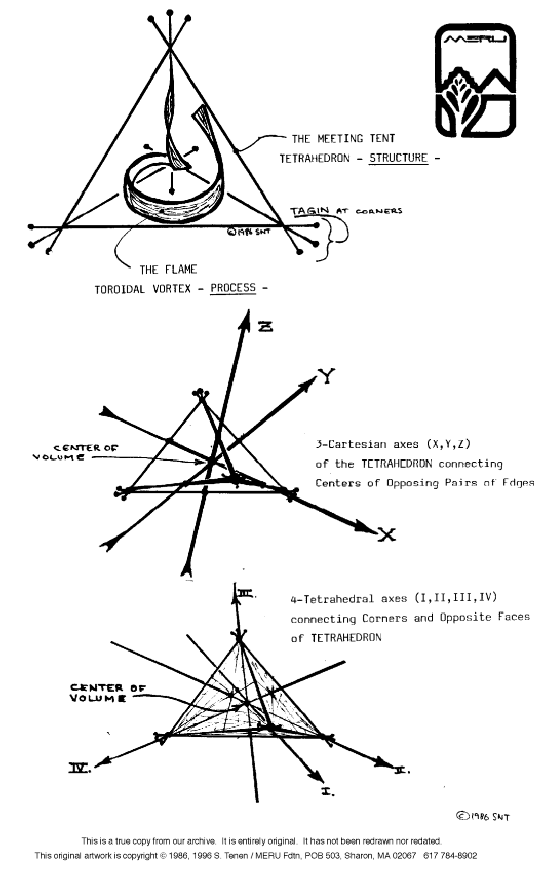
In three dimensions the most elegant economical structure exhbiting total symmetry is the tetrahedron. It has spin symmetry about all its elements:
         4-corners (opposite 4-faces)   ---   Defining 4-tetrahedral radii

                                                           and

         6-edges (in opposing pairs)    ---   Defining 3-"Cartesian" radii
Thus, the tetrahedron is completely defined by 7-radii/vectors (see accompanying illustration). In fact, the tetrahedron is the minimum element (quantum) of all structure. (These concepts are discussed at length in "Synergetics" and other works by R. Buckminster Fuller.)
The tetrahedron is also a representation of the (symmetric) structure of the minimum set of four logical elements that define the self-referential (reflexive) process.
The simplest 3-dimensional representation of the most asymmetric form is less often recognized. We propose this simplest asymmetric form as the corresponding defining element of the self-referential (reflexive) PROCESS itself, complementary to the minimal logical STRUCTURE of the process as described above. In fact, this most asymmetric form is the minimal (topologic) form of any/all process which begins from the uniform homogeneous chaos of nothingness/anythingness (Ain Soph, in Qabalah).
As an analogy, picture this nothingness/anythingness as a sort of infinite "cosmic jello". The introduction of any disturbance whatever into this "cosmic jello" is of indeterminately large magnitude, compared to the previously undisturbed state. (This "first cause" is the equivalent of Prigogine's dissipative flux.*) It results in the reflexive flow of uniform isotropic "cosmic jello" through itself as defined on the surface of a 2-torus (donut); sort of a "smoke-ring" set into motion (puffed from the contraction-zimzum) by the dissipative flux of first cause: "Fiat Lux", the introduction of light/consciousness into the void. (This 2-torus form as the archetype of the self-referential process is discussed in detail in "The Reflexive Universe" and other works of Arthur M. Young.)
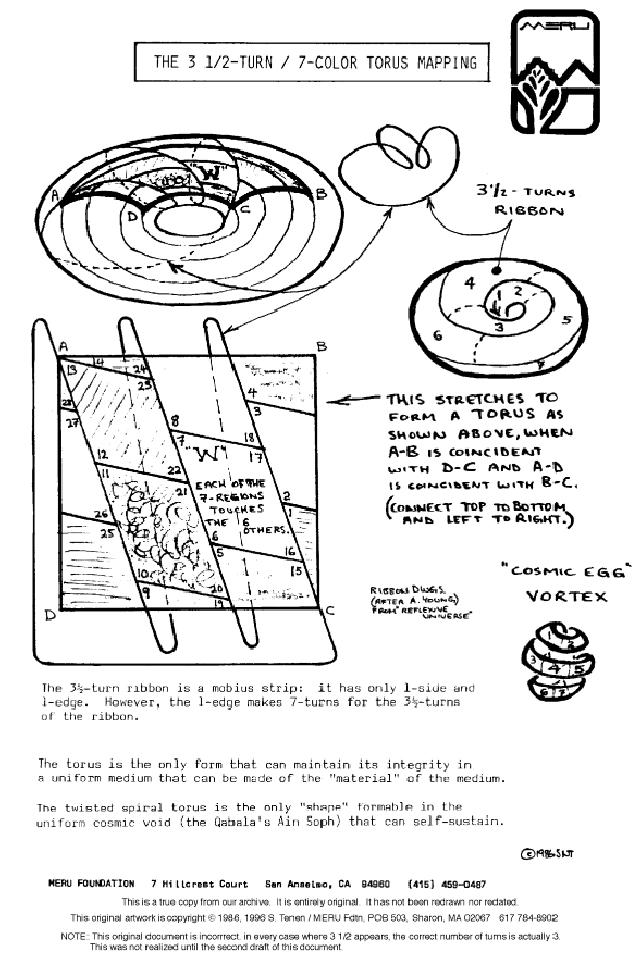
The 2-torus (donut) is invariantly defined by the 7-color map that can be drawn on its surface; the 7-regions are cyclically arrayed on a 3 1/2-turn ribbon carved on this surface. (See illustration.)
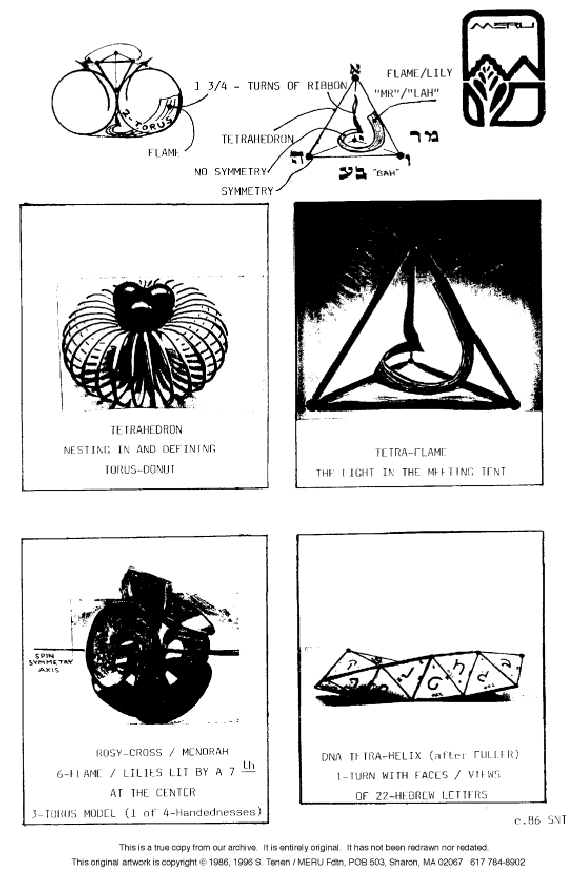
We propose that the most elegant representation of total asymmetry in 3-dimensions is one half of this ribbon: 1 3/4-turns of spiral vortex extending from the singularity at the center of the donut up out and around to its circumfrential rim. (If we model our 2-torus as a radial tire on an infinitesimal wheel, then the spiral vortex unfurls from the axle hole to the center of the tread.) Each view of this ribbon is unique; it is completely asymmetrical in 2-dimensional (shadow) projection.
This complementary pair, the regular tetrahedron and the 1 3/4-turn ribbon vortex, together represent the archetype that defines the distinction between perfect symmetry and no symmetry at all. The defining elements of each correspond one-to-one with the defining elements of the other (i.e., they map each other.) The seven radial vectors (axes of spin symmetry) which define the tetrahedron correspond to the seven cyclically arrayed regions (7-phases) of the 7-color map (on the 1 3/4-turn ribbon) which defines the 2-torus. Further, the progression from the apex of the tetrahedron to its three base vertices maps onto the eruption of the singularity of the 2-torus to its rim; the three base vertices of the tetrahedron also define the cyclic spin direction of the 1 3/4-turn ribbon as it spirals out from "axle" to "rim". (See illustrations.)
The tetrahedron has the form of the meeting tent, the tabernacle in Sinai; the vortex has the form of the Eternal Flame inside the tent. They are the Same (symmetric) and the Different (asymmetric) of Plato (Timaeus); the Urim (lights) and the Tumin (perfections), the jewels on the breast-plate of the high priest; the Yin of cyclic feminine process and the Yang of radial masculine structure. They are Spirit/Consciousness/Light in Matter/Body/Quantum.
----------
This Flame in its Meeting Tent has many noteworthy properties and applications; as a model known in the mythology and science of all cultures (albeit in various guises and by diverse names) it can function as a unifying center and speak to all with one voice.
It is taught that the twelve perfect jewels (Tumin) on the breast-plate of the high priest in Sinai, in appropriate prophetic hands, could be used as an oracle in interpretation of the Torah.
In the introduction to the Sepher Zohar (Book of Splendor), Rabbi Simeon discusses the "lily among the thorns". The thorns are like seed-husk/ structures; they are "particles" akin to the tetrahedron. The lily (calla lily -- the "Easter Lily" to the Christians) is flame-shaped, but upside-down (the candle-top is at the open end of the lily; the smoke column from the tip of the flame is at the flower's stem). The lily grows from within its thorn just as the flame flares from within the tetrahedron.
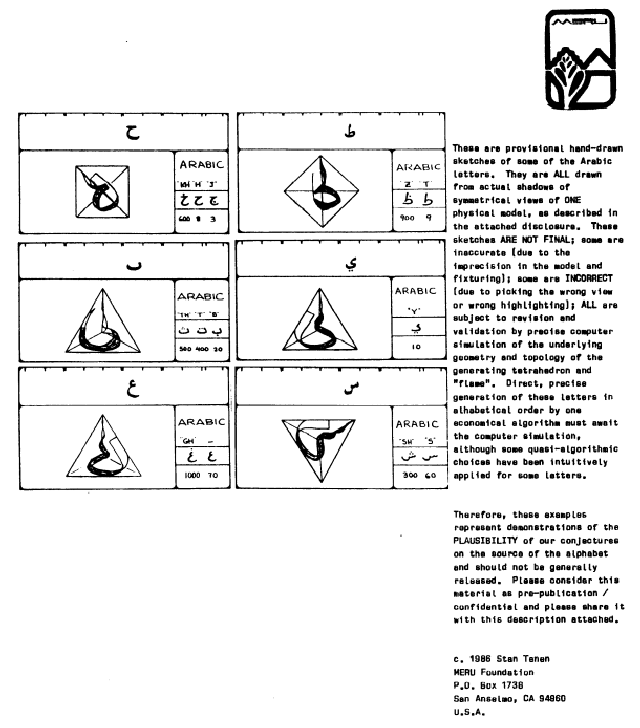
The Sufis teach that the second letter of the second sura of the Quran, the super-letter "Lah", is the source of all (Arabic) letters. The Lah is a flame, the Light of Islam, and it appears in a triangle (plane representation of a tetrahedron) on Moslem gravestones. It is a symbol of Unity/Light/ Consciousness.
In the eastern traditions this model appears as the tortoise that holds up the world. (The tortoise shell is the structural quantum, while the hexagonal pattern on its back is an exact model of the cyclic 7-color map that defines the 2-torus/donut.)
The tetrahedral Tripod was the seat of the oracle at Delphi.
The Oroboros (the snake that eats its tail), the Orphic Egg, and the entwined serpents on the Caduceus are representations of the same 2-torus defining ribbon.
When Yin and Yang interflow in the Tao, when Spirit is at home in Matter, when mind and body are healed (whole) in one soul, when Urim is in Tumin, when wave and quantum are light they then can all be represented by the 1 3/4-turn ribbon vortex FLAME in the TETRAHEDRON.
----------------
It has been proposed by David Bohm (in his recent book, Wholeness and the Implicate Order) and by other modern and ancient theoreticians (including, of course, Plato in his famous allegory of the cave) that there is a higher dimensional holodynamic plenum of which our world and all that it contains is but a shadow projection. In modern terms, this holodynamic plenum is understood as an interference pattern -- an interpenetration of two (or more) beams of light-waves. (Cast pebbles into a lake and watch their ripples intermix.) An ordinary hologram consists of the sea of intermixed ripple-waves from a reference light and ripple-waves reflected from a (3-dimensional) object whose pattern is frozen on a photographic plate. The least elements of this hologram are the set of all possible phase combinations of the interference of reference and object light waves.
Our flame is the defining element of a 2-torus/donut. Like a "radial tire" , the 2-torus is a "wheel of wheels" (to paraphrase Ezekiel). Each "wheel" is a 360-degree phase cycle. When the tetrahedral frame is tipped through its symmetry set (discrete quantum steps) and spun or rolled (cyclically) on its edges and axes, the flame within exposes to view its set of distinct shadow projections. Each view of the flame is unique. These natural symmetries of the tetrahedron cast views of the flame which are the letters of the Hebrew, Greek (script) and Arabic alphabets (see accompanying examples). When we view these intermixed flame phase-wheels through all the symmetries of their tetrahedral "meeting tent", we are in fact looking at the natural set of all the elements of a hologram.
It is because the Hebrew, Greek and Arabic letters are this set of elements that they are called "holy" (of the whole). As our traditions have taught, they are the sacred elements out of which our reality is actually formed. A sequence of these flame-letters can function as an "oracle" (e.i. a tool for reading) to describe the motion of the tetrahedron on or around any object, thus defining a static real object or even a sequence of unfurling living forms. (See our paper on TetraFlame Graphics and other discussions for a descriptions of the use of these letters to read and write a holographic image, to read and write a "text-string" letter sequence describing 2, 3, and 4-dimensional objects, and for how the 22-letter Hebrew alphabet casts one archetypal turn of D.N.A. by rotation of the tetrahedron as Fuller's tetra-helix.)
These letters are the natural
(not arbitrary) elements of the
logical structure of the
reflexive process of our
self-aware consciousnesses. They
represent the natural quanta of
all that we perceive of this
reality: the essential facets
through which we view all that
is. They bridge the archetypal
distinction of symmetry and
asymmetry. They are the most
economical, elegant and
universal set of letters of
natural language: the
eigen-values of life.
* "Order out of Chaos" 1984,
Ilya Prigogine & Isabelle
Stengers
** See additional discussion of
Meruba in TORUS, the MERU
Foundation journal, issue I.5.
---------------
********************************************
We will consider the following supplementary

descriptions and detail the applications

mentioned below in future discussions.
View
the "Lah Swath" in Color
(This
notation not part of original
document)
The accompanying "LAH" drawing
illustrates how the flame
corresponds to the embryonic
growth process and the
unfoldment of dimensionality as
modeled by the unfurlment of the
Platonic regular and semiregular
polyhedra. The LAH-flame is the
flower that blooms on every
vertebra of the "Great Chain of
Being". In the Hebrew and Latin
signs, the LAH is represented by
MER, "the sea", the elementary
vortex of wave motion. This is
why the name of the Hebrew
alphabet is MERUBA.**
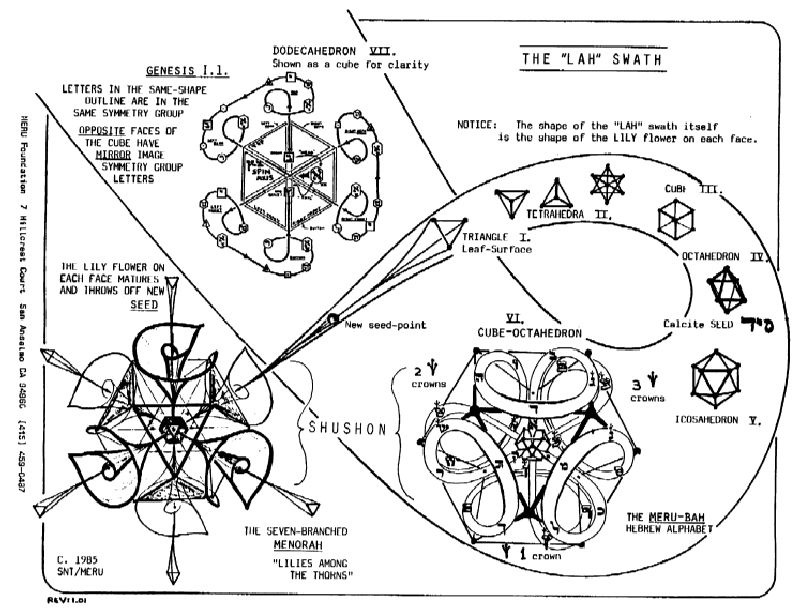
The LAH-Swath represents simultaneously:
The embryonic growth process -- seed, stem, leaf, bud, flower....new seed.
The geometric growth of dimensions -- point, line, surface, volume, hypervolume....new "fiber bundle".
The unfoldment of the semi-regular and regular Platonic polyhedra -- point (0), triangle (I.), tetrahedron (II.), double-tetrahedra (II.), cube (III.), octahedron (IV.), icosahedron (V.), cube-octahedron/vector-equilibrium (VI.), rhombic dodecahedron (VII.), ....(sphere).
The growth and unfurlment of the Meruba Hebrew (and perhaps Greek and Arabic) alphabets....and the beginning of the Hebrew text of Bereshit (Genesis).
This pattern is hierarchical: notice that the lily-ribbon-vortex "flame" seen unfurling on each face of the alphabet cube-octahedron, and on the face of the Bereshit (Genesis) and calla-lily forms, is itself a new embedded LAH.
In Bereshit (Genesis) the first distinction is between "Heaven", the flame's spiral reaching, above, and "Earth", structured, below. The first letter is Bet (B).
The sequence of flame-letters also follows the stages in the growth of consciousness in a new-born child. The alef (A) is the first light of birth, the as-yet undifferentiated whole. The bet (B), traditionally interpreted as an archetypal "house", distinguishing in-ness from out-ness, is also the first distinction in consciousness -- the infants's recognition of the difference between its inside (where food goes) and the rest of the universe (mother, the "other" from which the food comes). This is the first component of personal identity. We expect that it can be shown that this letter by letter unfoldment of personality continues through the alphabet.
A program from the Public Broadcasting System series NOVA titled Life's First Feelings (Copyright 1986 by WGBH, broadcast in San Francisco on 11 February 1986), which came to our attention the day after the above was written, continues this alphabet/personality development. In this broadcast, research is presented which suggests these six stages of child personality development (Hebrew Alef-Bet correspondences added by SNT):
Stage 0 -- BIRTH         Innate interest in stimulus (sight, sound, etc)-   --   --   -- ALEF

Stage 1 -- to 2 months   Self-regulation  Makes sense of the world -   --   --   --   -- BET

Stage 2 -- to 4 months   Falling in love  Ties to others; need to interact  --   --   -- GIMEL

Stage 3 -- to 8 months   Communication    Emotional dialogue; touch; trust/confidence -- DALET

Stage 4 -- to 18 months  Complex self-sense  Initiative/purpose   --   --   --   --   -- HEY

Stage 5 -- to 24 months  Leap  Organized creation of ideas; emotional thinking;

                         "mind's eye" image of loved ones; acting out/make believe-   -- VAV

Stage 6 -- to 48 months  High-level sense of self and others

                         Elaborate fantasies; anticipation; cause/effect-   --   --   -- ZAYIN

(Stage 7 -- 4 years +    Human Beings--   --  --   --   --   --   --   --   --   --   -- CHET)
Transcript of program available from NOVA, c/o WGBH Boston. (Ordering information on videotape -- Beta III)
----------
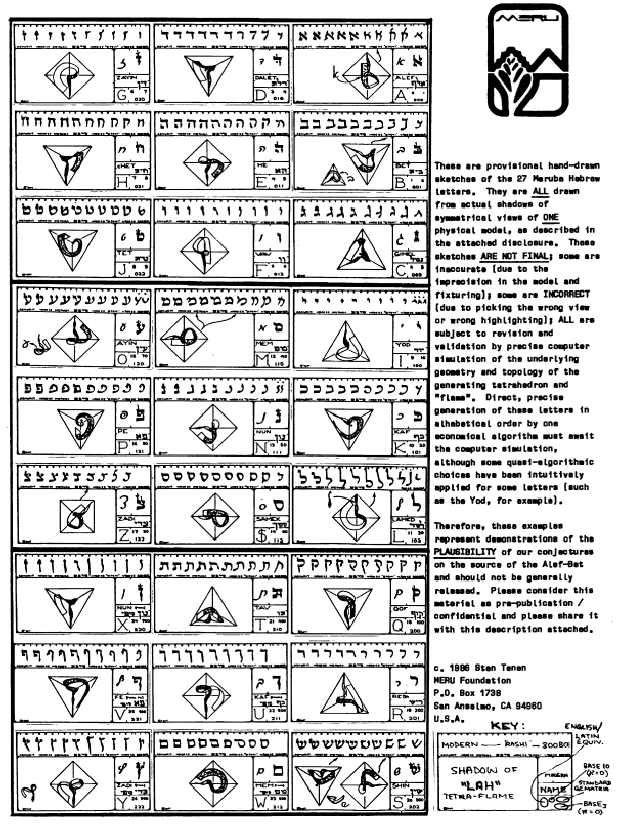
The Tetra-Flame is also an integrative interdisciplinary educational tool. The same central image can be shown in all cultural contexts to inter-relate instruction in:
The various alphabets -- showing commonality of heritage and its source in unity -- (Tetragrammaton).
     Geometry

     Topology

     Logic

     Set theory

     Comparative religions/cultural traditions

     History

     Computer theory and Artificial Intelligence -- self reference

     Computer graphics -- TetraFlame graphics

     Dance -- Laba-notation; Ribbon dance

     Music -- "of the spheres"

     Elementary particles in physics -- SU(3) set

     Microbiology -- D.N.A. topology; reading genetic makeup as mature form

     Crystallography/interferometry/transform imagery

          ....and many others and at all levels (from the 3-R's to graduate

          school).
--------------
Most important of all is the potential of the TetraFlame -- the Light in the Meeting Tent -- to heal. Our ability to see and feel how process and structure are the essential complements of ourselves can show us the means to balance our mind in our body, our spirit in our soul. This flame can be the common light that unites our world of competing distinctions.
Contents of
this page are ©1986, 1987,
1996 Stan
Tenen, and licensed to Meru
Foundation, 524 San Anselmo
Ave. #214, San Anselmo, CA
94960.
Email inquiries to: meru@meru.org