
| Help Support Meru Foundation Research |
 |
©1990 Stan Tenen
Director of Research, Meru Foundation
We have discovered an extraordinary and unexpected geometric metaphor in
the letter sequence of B’reshit (the Hebrew text of Genesis), a text which
underlies and is held in common by the spiritual traditions of the ancient
world. This metaphor models embryonic growth and self-organization. It
applies to all whole systems, including those as seemingly diverse as meditational
practices and the mathematics fundamental to physics and cosmology.
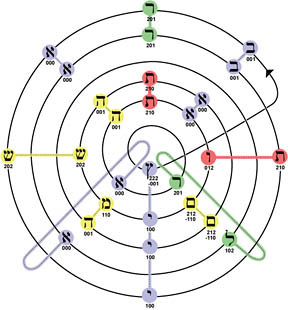
The metaphor also serves to explain the origin of and reason for traditional claims of sacred status for particular alphabets and texts, and it demonstrates a level of commonality among teachings in different traditions based on the self-aware nature of our consciousness and the self-propagating nature of life. We have found that the letters of the Hebrew (and, later, likely the Greek and Arabic) alphabet, because of the unique means of their generation, represent fundamental directions in a hyperdimensional space. This makes them ideal as elements of a natural algebra for theoretical physics. It also identifies the letters of the alphabet with the perspectives of conscious focus that are the inherent elements of our self-awareness and of our inner meditational and emotional reality.
We believe that such an alphabet, based on the geometric metaphor we have identified, can specify physical and psychological states simultaneously. Physicist Nick Herbert in his discussion at the end of his book, Quantum Reality, Beyond the New Physics, states: "One of the greatest scientific achievements imaginable would be the discovery of an explicit relationship between the waveform alphabets of quantum theory and certain human states of consciousness." Used with the author’s permission; ©1985 Anchor Press/Doubleday, p. 249.
Meru Project findings demonstrate that the relationship between physical theory and consciousness, expressed in explicit geometric metaphor, was understood and developed several thousand years ago. This relationship also explains the paradoxical affinity of our spiritual traditions for what seems to be number mysticism and geometric form. While this theory may require us to reassess common presumptions about the nature and quality of our spiritual traditions, it will also serve to reinvigorate the healthy core of these traditions, illuminate their origins and their inherent differences, and make clear how the growth of our civilization was and is dependent on them.
These concepts were developed and claimed by a wide range of otherwise distinct traditions because they are common to all human experience. Therefore, the geometric metaphor could serve as a bridge of mutual respect and understanding between these traditions, without blurring the critical distinctions that make each unique. The common geometric tools of the original Hebrew and later Abrahamic and Greek world-views can be seen in perspective, demonstrated, and mutually appreciated. (Similar concepts also appear in eastern traditions, but this has not been explored.)
This model, because it is based on self-propagation and embryonic growth, can be applied to the study of a wide range of self-organizing, independently acting, and self-learning systems including those associated with artificial intelligence and expert systems.
This is also an ecological model with immediate applications. It illustrates the inherent interdependent organic structure of whole systems. It was - and is - intended to be applied to social, psychological, political, and commercial organization.
This is a powerful interdisciplinary model. It can integrate embryology, geometry, physics, language, psychology, athletics, and dance into one educational system. Young people find that this model provides an intuitive foundation and appreciation for hyper-dimensional concepts and their relationship to organic growth and self-organization.
The geometric metaphor is a powerful aid to understanding the historical impact of mathematics, as well as its essential place in our lives.
Stan Tenen, Director of Research, MERU Foundation
Written Fall 1990, San Anselmo, CA
Meru Foundation, 524 San Anselmo Ave. #214, San Anselmo, CA 94960.
Email inquiries to: meru@meru.org