
| Help Support Meru Foundation Research |
 |
How to Talk to an Extra-Terrestrial
What if the source of information is also the sign of information?
As published in
the peer-reviewed NOETIC JOURNAL,
VOLUME 3 NUMBER 2 (July 2002)
©2000, 2002 Stan Tenen
A
Journal-Reprint version of this
article in Adobe Acrobat format is
downloadable at
www.meru.org/Noetic/ShapeofInfoA3HiTOC.pdf
Table of Contents for Vol.
3 #2 of the Noetic Journal:
The Noetic Journal
An International Forum on the
Cosmology of Consciousness
Volume 3 Number 2 April 2002
Referred Papers
Theories of Brain, Mind &
Consciousness: Still Great
Divergences
M. Draganescu
Meaning as
Consciousness A. B. Lohrey
The Future of Psychiatry and
Psychology: Conceptual Challenges
from Clinical Consciousness
Research S. Grof
The Importance of Quantum
Decoherence in Brain
Processes H. P. Stapp
Computationalisim and
Anthropocentrism: That Old Double Standard M. M. Cirkovic & A. Vlajkovic
The Shape of Information: How to
Talk to an
Extra-Terrestrial S. Tenen
Direct Experience of the Universe
A. Sorli
Consciousness: A Thousand Points
of Light; Biophoton
A Fuzziness Approach to Universal
Consciousness
N. Bulz
The
Shape of Information: How to
Talk to an Extra-Terrestrial
by Stan Tenen
Abstract
Whether or not there actually are extra-terrestrials, it is worth considering what it would take to communicate with self-aware beings from thousands of light-years away in space, because this may shed light on how we can understand formal records (sometimes called "sacred") left for us by human civilizations thousands of (earth) years away in our own past. For this reason we ask: What if ancient, traditional, "sacred" numbers, letters, and symbols were, somehow, exactly what they meant? This claim of intrinsic natural universal meaning is, after all, one of the claims generally made. Usually these claims are easily dismissed, or they are reduced to the trivial by interpretations that explain them away as vestiges of numerology, gematria, and mythological meaning. This essay attempts to outline an alternative view. We find that the natural geometry of the cosmological, quantum-mechanical, and personal information gradients of all information systems follows the same topology, and can take the same geometric form. At the quantum-mechanical level, we find the twice-around orbit of the Dirac String Trick gives us a pair of spiral vortices, and Arthur M. Young’s 3-turn torus-hypersphere model of the photon—which he relates to the quantum of personal choice—gives us a similar set of spiral vortices. At the cosmological level, the negentropic star-plant-planet information-gradient described by Roger Penrose takes the same form. And at the personal level, our human hands, which are the form(s) we use to project our choices into the world, can also be idealized by the same spiral vortex form(s). In all three cases, cosmologically "as above," quantum-mechanically "so below," and in the middle on the "earth plane" where we live, we find the negentropic information gradient takes the same form—and this form shows up throughout ancient symbolism and at the root of the three great "sacred alphabets" in the Western traditions.
Keywords: Cosmology, Language, Meaning, Quantum theory, Information
1. Introduction
One of the enigmas of ancient philosophical teachings is their persistent claim that somehow, the symbols and symbol systems they chose to call "sacred" were natural, obvious, and self-meaningful. The claim is that these symbols were in no way arbitrary. These claims have been interpreted in simple ways that are not philosophically satisfying, and consequently they have been written off as religiously or culturally motivated puffery with no meaning beyond that. These sometimes fascinating but limited views are consistent with our modern assumption that ancient scholars and philosophers were satisfied with primitive, non-elegant, simplistic, and informationally shallow conceptualizations. It is usually assumed that our predecessors were not concerned with rigor, had only approximate knowledge, accepted superstitions, and had no formal mathematics or science—so how could it have been otherwise? As I hope this essay will help to demonstrate, the limitations based on these assumptions may be gratuitous—more in the eye of the beholders (in our time) than real. They also demean and diminish the value of the "perennial traditions" of ancient thought, and the religious and spiritual traditions that continue to depend on the values and concepts originally developed in the ancient world. The modern scholarly perspective diminishes what we expect of these traditions, and ultimately their legitimacy as well.
There have been many scholarly and not-so-scholarly investigations of "Pythagorean number symbolism," gematria, and numerology. These discussions have centered on the supposed "mystical" and mythical meaning of geometric shapes, numbers, and letters, or on the history of the subject. Only rarely have they included the possibility of an informationally deep meaning in a modern sense. Regardless of the validity of this approach in some cases, if there really were informational depth and sophistication—in a modern sense and in the context of modern standards—in the symbol systems of traditional philosophies, than the current consensus effectively "damns
[these claims] by faint praise." Scholarly praise for explanations that do not meet modern standards makes these systems appear to be shallow and trivial from a modern perspective, and this has usually been sufficient to dissuade the search for greater depth by researchers more prepared to find it.
2. A New Approach
I would like to suggest that we reopen the investigation of "number and letter symbolism," with an eye to the possibility of a deeper, more philosophically interesting, and indeed, more practical approach. IF there is sufficient universality and informational depth to traditional symbol systems, they might even be adapted for, or provide insight on, possible systems for communicating with other self-aware, conscious, volitional beings such as primates, cetacea, elephants, and, of course, extra-terrestrials. Not only do self-aware earth creatures share their self-awareness with the sort of terrestrials and extra-terrestrials we would like to communicate with, but they also share the same physics, and—if what we are about to suggest is a valid approach—similar "star-planet-sky" environments. And, of course, the informational physics of the biological systems that can lead to self-aware volitional consciousness is always the same.
To start, we might ask: What if claims of intrinsic natural meaning for these "sacred" numbers, letters, and other symbols are true in a philosophically deep way?
What if ancient "sacred" numbers, letters, and symbols were, somehow, exactly what they meant?
What if the natural geometry of the source of information also serves as the sign of information?
What if the natural geometry of the source of conscious volition also serves as the sign of conscious volition?
Part 1: What is the source of information? What is the natural geometry of information? What informs life? What informs us?
Roger Penrose, in his book The Emperor’s New Mind, tells us that the source of the negentropy (information) needed for the biological (mechanical) self-organization of living plants is in the contrast between the small, central, bright sun, and the large, surrounding, cold, dark sky.[1] This is because the narrow solid-angle, collimated, white light photons that reach us from the sun carry more negentropy (more organizational information) than the fully dispersed, uncollimated, infrared photons that the plants and earth radiate back to the wide solid-angle sky. If the sun and the sky had the same extent, temperature, and spectrum, there would be no contrast between them and thus no information gradient for the plants to exploit. If the sun were not white-hot and narrowly focused, and the (earth or) sky were not cooler and all-around, there would be no way for the plants to extract energy or information, and they would not live. We would not live either, because we depend on the plants to extract the information needed to build the proteins and other nutrients that we eat. If our bodies could not grow, then neither could our volitional minds grow.
Thus the life-giving information source itself consists of the topological relationship of a central point (the sun) surrounded by a sphere (the sky)(see Note 1). Radii reach out in all directions along the information gradient from the central "sun"—to the earth—to the surrounding "sky". The plant’s leaves "swallow" solar photons and "stretch" themselves above (stem, trunk) and below (roots) the earth, so as to grow along the radii of the sun-earth-sky information gradient. Many less sophisticated cultures—those that observe only the physical world, and worship physical deities—use the symbol of a point inside a circle to represent their "solar-source" deity (some even include various representations of radii or target-markings in or around the circle-and-center symbol).[2]
In my essay Man Bites Dog[8] I expand on this "center-sphere" and "surrounding-sphere" model by suggesting that there is an analogy to the plant’s informational situation in the emergence of volitional consciousness in self-aware beings, such as ourselves (and extra-terrestrials). By examining the same contrast-relationship (topology) model in a 4-dimensional context, we can abstract and upgrade our idealization of the 3-dimensional "sun-sky" model for the plant’s mechanical self-organization so that it can apply to our "hyper-mechanical", self-organizing, volitional consciousness model. (See Man Bites Dog, as above.) The "center-sphere with surrounding-sphere" geometry can be understood as one of the 3-dimensional projections of a 4-dimensional hypersphere. (This is analogous to the 3-dimensional projection of a 4-dimensional hypercube which looks like a small cube inside of a larger surrounding cube with the corresponding 2-sets of cube-corners connected.)
| In-Cube
/ Out-Cube Tesseract model of a 4-D Hyper-Cube
CUBE
HYPER-CUBE |
In-Sphere
/ Out-Sphere (shown in cross-section) 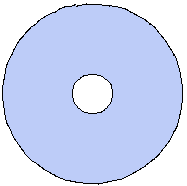 HYPER-SPHERE |
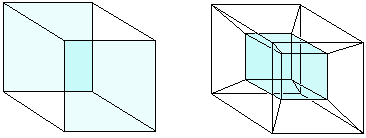
Now we have the contrast relationship of a central informational source-sphere surrounded by an all-absorbing informational sink-sphere in the form of a 4-dimensional hypersphere. We are already familiar with, and we know how to model, the link (i.e. the topology of the relationship) between a central point and a surrounding sphere. This is the Dirac model for understanding the 1/2-spin of an electron.
The electron can be modeled as a Dirac point particle represented by a delta function "surrounded by" and/or complementary to the probabilistic wave function which is the Fourier transform (the probability spectrum) of the delta function in Hilbert space (n-dimensional hyperspace). The delta function and its transform are orthogonal (at right angles) and complementary (bear a reciprocal relationship) in Hilbert space.*
Dirac’s "String Trick" provides us with an accurate, visualizable, geometric metaphor for the electron’s 1/2-unit of spin.**
The geometry of the Dirac String
Trick is explored in "storyboard"
animation cells, outlines of the
full twice-around orbit, and
discussion in The Dirac String
Trick: First Hand, are at www.meru.org/dirac.html.
The Dirac String Trick is also
directly related to the
quasi-4-dimensional
"quaternion—i,j,k—hand-shake" as
has been so elegantly demonstrated
by knot theorist Louis Kauffman,
Ph.D., U. Illinois, who also
provided the String-Trick
storyboard animation below.
Dirac String Trick Storyboard, courtesy of Louis Kauffman, University of Illinois, Chicago
|
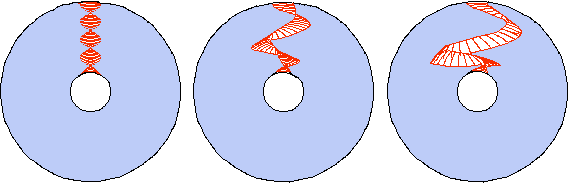
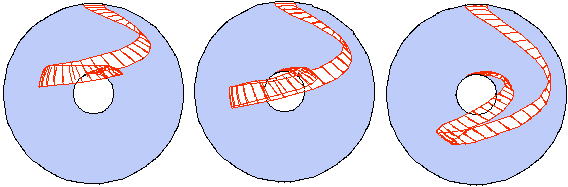
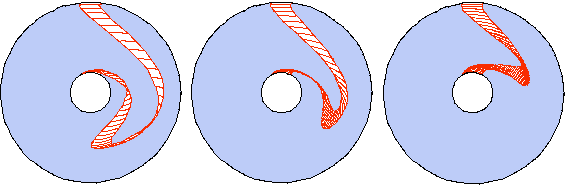
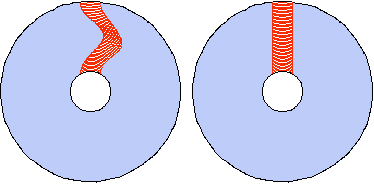
Here we notice—as Dirac pointed out—the similarity between the 3-dimensional path of a hand performing the "Philippine Wine Dance" (also traditionally known as the "Flame Dance", the "Candle Dance", or the "Plate Dance") with the winding and unwinding of the electron’s "Dirac String". It also takes "twice around" for the dancer’s palm (and the wine-glass or candle-flame held upright in it) to return to its initial position. (Holding the wine-glass prevents us from turning the palm of our hand over, because that would spill the wine—or, in the case of the candle-flame, extinguish the flame or burn our hand.)
Because of its surprising universality and its ability to "point in 4-D", the orbit of the traditional dancer’s hand might be adapted as a truly natural, and truly universal, minimal dynamic model of the source of the dancer’s (and our own, and any putative ET’s) volitional consciousness. The half-orbit may be even better suited, depending on how we define things (see the illustrations in The Dirac String Trick, First Hand, as above). It has the advantage that when it is divided in half horizontally, the Dirac String Trick orbit produces a left-right pair of half-orbits. Each half-orbit can also be used to define 1/2 of the surface of a 2-torus (donut, inner tube) that has further meaning which we explore below.
The Philippine Wine Dance as the Orbit of the Dirac String Trick
Right hand path shown. The right hand path and left hand path are the same, but inverted Photograph of 2-First Hands(TM);
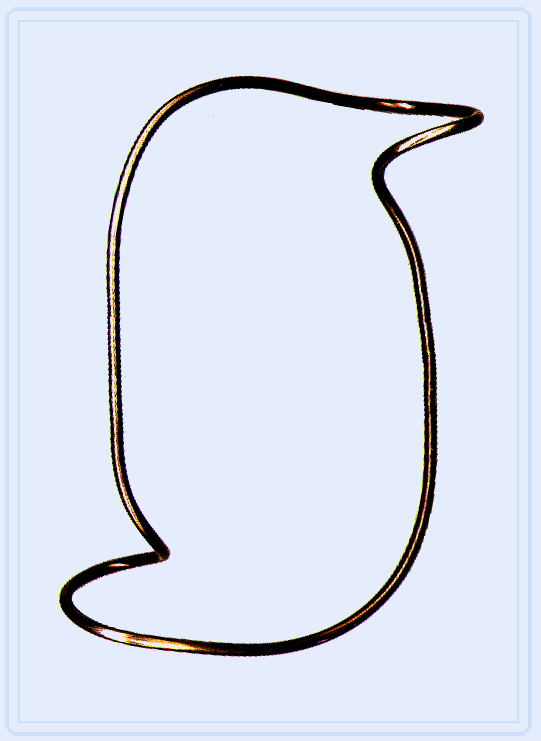
The right-handed (above) and a left-handed (below) pair of vortices of the Dirac String Trick orbit.
The pair of vortices trace the path of the Philippine wine dancer’s hands for each cycle.
The informational gradient of the sun-planet-sky topology is universal (even if ET’s world has two or more suns) because it is universally required for self-organization. We share it with extra-terrestrials. An ET’s plants also grow because of the contrast between their sun(s) and their sky. And, of course, "ET electrons" are identical to our own so their spin is modeled by the Dirac String Trick even if their "hand-arm-wrist" systems might not match the quaternion i,j,k rotations (something which we currently have no way of knowing) and might have more or less freedom of motion than ours.
Part 2: Pointing IS Information.
Because it is a minimal, elegant—and an asymmetrical—representation of the source of information, and because each different orientation of a completely asymmetrical form is distinct, the half-orbit of the dancer’s hand can function as a universal pointer by which we can indicate our choices. This is crucial: Arthur M. Young, in The Reflexive Universe[3], discusses the relationship between pointing and choice. Young contends that the "quantum of action," Plank’s constant h (essentially, the photon), can be usefully identified with the quantum of conscious choice—a yes–no decision. Young also points out that we cannot know a priori the precise timing or direction of the emission of a photon—which is the information photons carry—in the same way that no outside observer can know a priori our conscious choices—the information we carry—while they are still only in our mind. Given that silence implies consent, Young also insists that the first volitional choice is "No."
We need a pointer not only so we can point to what we want others to notice in the everyday world (hand-gestures), but we also need a pointer when we "shine the spotlight of our attention in the theatre of our mind," and we need a pointer—the quantum state vector—when we want to designate entities and "navigate" in modern physics. A communication system based on appropriate symbolic embodiments would include a minimal, elegant, pointing system which could be truly universal—both horizontally among self-aware creatures (always and everywhere) and vertically from within our private minds ("heaven"), among each other ("earth-plane"), and in formal mathematical abstractions of modern cosmology and physics (microscopic and macroscopic "sky").
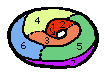 The contrast between
the small central source and the surrounding sink is fundamentally asymmetrical.
This can be seen directly when the
hypersphere is projected back into
3-dimensions in the form of a
2-torus. Arthur Young has shown
that the topological properties of
the surface of 2-torus can be
modeled by an elegant, minimal
7-color map with the "colored"
regions strung sequentially on a
3-turn spiral vortex. [3]
The contrast between
the small central source and the surrounding sink is fundamentally asymmetrical.
This can be seen directly when the
hypersphere is projected back into
3-dimensions in the form of a
2-torus. Arthur Young has shown
that the topological properties of
the surface of 2-torus can be
modeled by an elegant, minimal
7-color map with the "colored"
regions strung sequentially on a
3-turn spiral vortex. [3]
This topology of an In-Sphere embedded in an Out-Sphere (which also continues to define the surface of a hypersphere) can be associated with a particular geometry, a 1½-turn spiral vortex, a dimpled-sphere torus, in a complementary, symmetrical, geometric frame: a tetrahedron.*
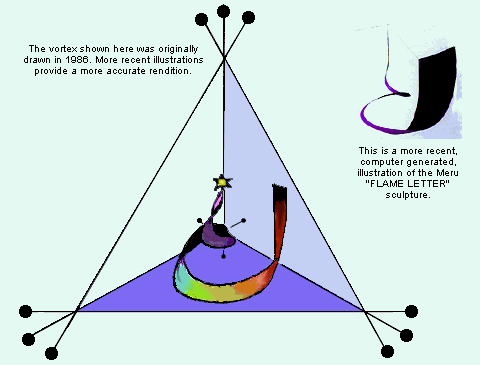 This topology of an
In-Sphere embedded in an
Out-Sphere (which also continues
to define the surface of a
hypersphere) can be associated
with a particular geometry, a
1½-turn spiral vortex, a
dimpled-sphere torus, in a
complementary, symmetrical,
geometric frame: a tetrahedron.*
This topology of an
In-Sphere embedded in an
Out-Sphere (which also continues
to define the surface of a
hypersphere) can be associated
with a particular geometry, a
1½-turn spiral vortex, a
dimpled-sphere torus, in a
complementary, symmetrical,
geometric frame: a tetrahedron.*The stark contrast between the total symmetry of the tetrahedral frame (the most suitable, archetypal, minimal "Tent") and the totalasymmetry of the 1½-turn spiral vortex is topologically identical to the contrast between sun and sky.
The vortex form is a suitable
geometric metaphor for flame, fire
or "Light." Thus this (specially
shaped) asymmetrical spiral vortex
can represent the geometry of the
source of information (with and
without its naturally
complementary, symmetrical,
tetrahedral frame). The
dimpled-sphere torus is
traditionally, metaphorically
described as an "apple" (and as
Apollo, the putative "author" of
the Greek alphabet, which some
scholars tell us is cognate to
"apple", and as a-pollon,
meaning "not many" = One), as the
"world," as sofia (wisdom), as sufah (whirlwind), as "Sufi," and as the
kabbalists’ non-idolatrous "image
of God," Ain Sof.
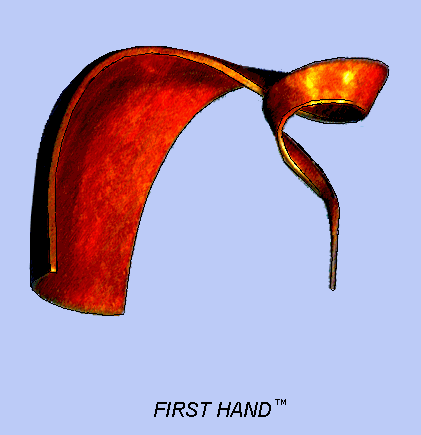
We propose that this specially shaped 1 1/2-turn spiral vortex is also what is referred to traditionally as the "flame of consciousness," the "light in Torah," the "light in the meeting tent," and many other similar "light," "flame," and "fire" metaphors. The geometric form (the geometric metaphor for) the source of the sun-sky information that informs our consciousness becomes the geometric form (the geometric metaphor for) the sign of information by which we inform (point with in) the world.
The specially shaped spiral vortex defines the surface of a 2-torus, which, as Arthur Young (who credits others) shows, can be understood as a 3-dimensional projection of a 4-dimensional hypersphere.[3] But, of course, this toroidal topology does not come with any particular geometric shape.
In order to find the geometric shape—the Shape of Information—that most suitably represents the information needed for self-organization, we have to look to the natural world. This is what brings us to the idea of modeling the torus after an idealized "apple," and the movement of a Sufi dancer.**Additionally, a powerful traditional model of self-organization is introduced in Genesis 1:11, where the text refers to a "fruit tree bearing fruit whose seed is inside itself." In this metaphor, a fruit—again, usually an idealized apple—provides the proper geometric shape.
Idealized Apple, Sufi Dancer, and Conservation of Momentum
This Idealized Apple can be represented by a dimpled-sphere torus, with the womb and seeds in the center hole, the stem and trunk identified with the fruit at its stem end, and the entire fruit identified with the whole sphere. The seed-tree-apple life-process spans from the torus’s hole to the whole torus—from an in-sphere (womb with seeds) to an out-sphere (fruit). This mini-sun (womb and seeds) in a surrounding mini-sky (fruit) recapitulates the form of the source of the information that informs the life of the apple-tree system. They are "made in the image of" the source that informs them. Notice also that this relationship-topology is the same as the traditional religious claim that humans are "made in the image of God."
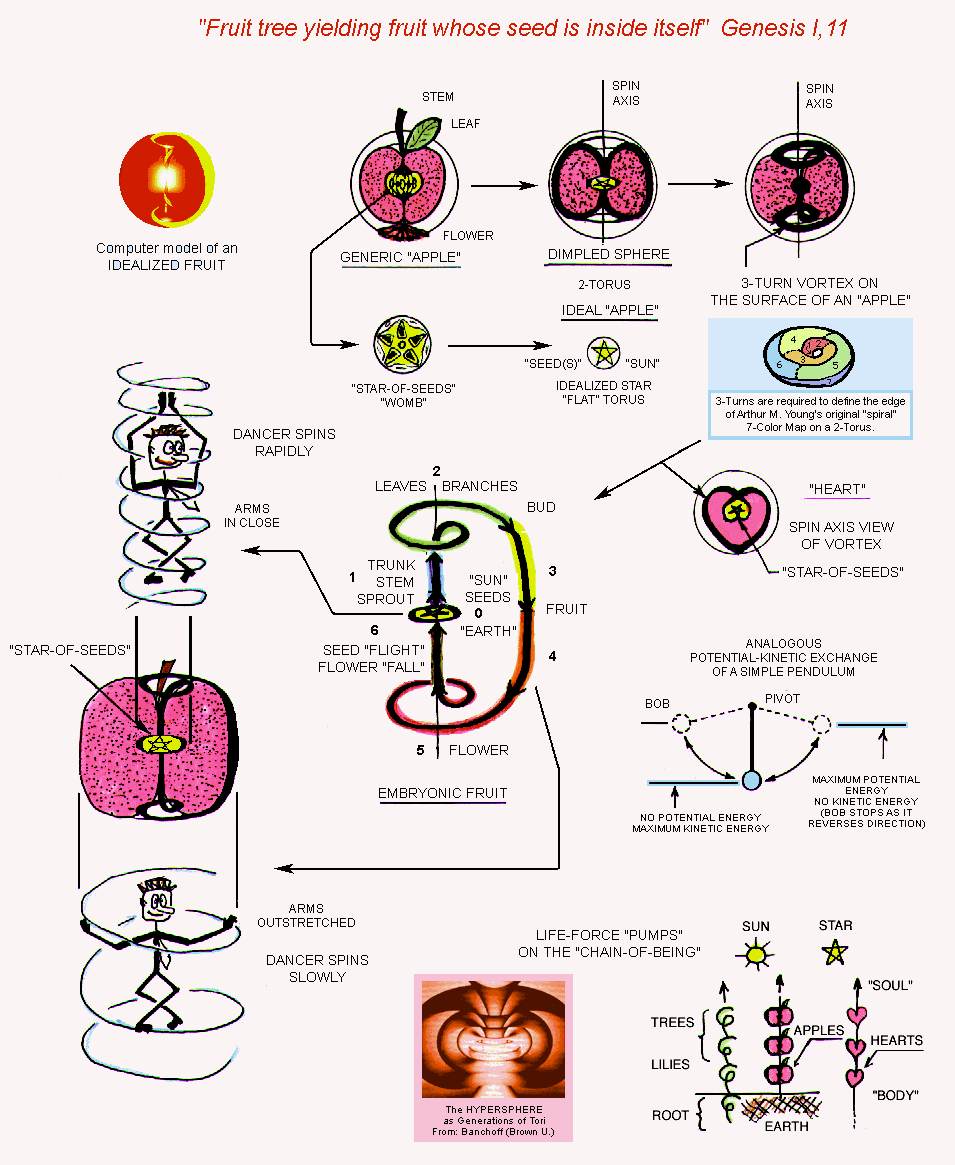
The dimpled-sphere torus (Edenic and Apollo "apple") had specific cosmological significance in the ancient world. Indeed, the word "world" is related to the idea of a "whirl", and the presence of consciousness in the whirled with the "whirlwind."
The spiral vortex on the dimpled-sphere torus—which strings out the 7 regions that topologically define the self-reference-modeling 2-torus—can also model the conservation of angular momentum. Again, Arthur Young shows how this self-referential process topology is useful in understanding angular momentum, and he suggests that these toroidal models are meaningfully related to the quantum mechanical unit of angular momentum, Planck’s constant, h, and to a "quantum" or "bit" of conscious volitional choice. [3]
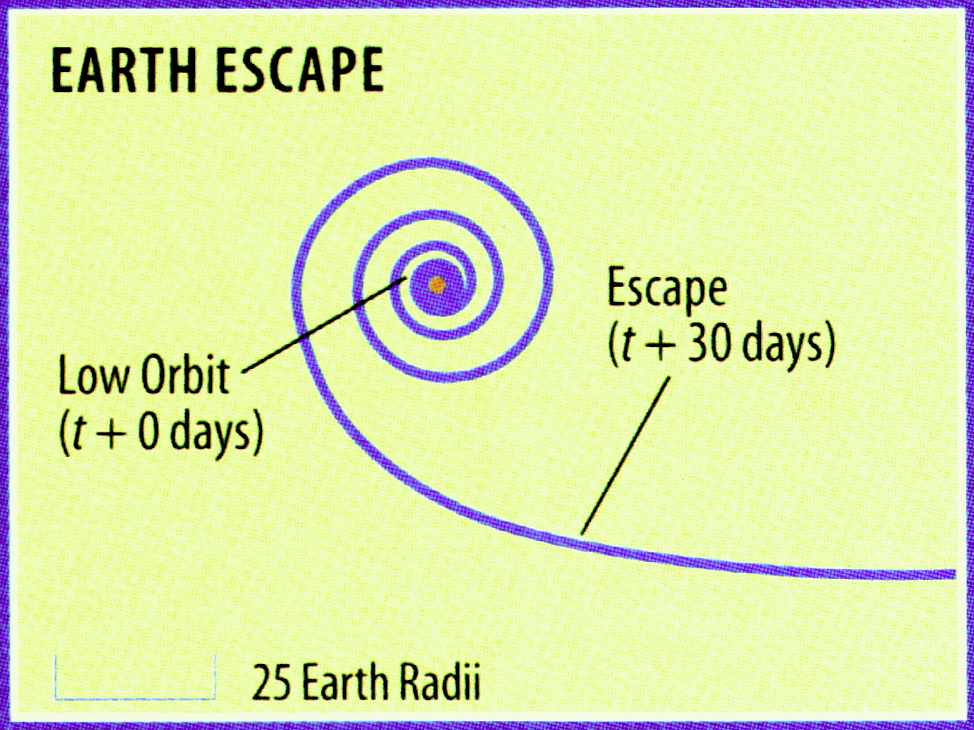
This EARTH ESCAPE graphic, right, is adapted from Scientific American, Nov. 2000, p.96 top. This is an example of the occurrence of the momentum-conserving spiral geometry of the dancer in the Idealized Apple illustration, above. It generates the spiral geometry of the idealized FIRST HANDTM, on the previous page, and it traditionally appears under the Egyptian Eye of Horus. This "earth escape" is certainly the sort of geometry that an extra-terrestrial would be familiar with. We have known of this momentum-conserving geometry since Newton. Some scholars claim Newton attributed his formulation of the laws of motion and gravitation to the insight he gained from his study of "Egyptian metaphysics" and his personal translation of the Hebrew text of Genesis.
Part 3: How do we inform others? Where is our conscious volition in the informational gradient?
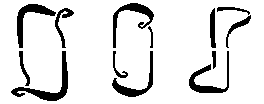
Whether by happenstance or design (an important theological question, perhaps, but one which we will not address here), our hands themselves take the same shape as the half-orbit of the Dirac "flame-dancer’s" hand. The complete, twice-around, Dirac String Trick orbit, split in two horizontally, makes a pair of 3-dimensional spiral vortex forms that fit our right and left hands perfectly. (See illustration below.)
An elegant abstract idealized model of the source of our volitional consciousness (the sun-sky contrast system) takes the form of our hands. Whether by coincidence, design, or as an inexorable (or optional) consequence of the evolution of biological form and the emergence of self-aware volitional consciousness, it is both astonishing and fascinating to notice that the cosmological (sun-sky) and quantum-mechanical (Dirac electron, Young photon) informational gradient that informs us, exactly fits in, on, and as our hands.
Not only does the half-orbit spiral vortex form serve as an effective abstract universal pointer, but also, our actual physical hands serve as our natural pointers. We use our hands to point to what we want. If we do not use a part of our bodies to designate what we want, that information will remain private (as private as the timing and direction of a photon event). When we wish to project our personal subjective inner thoughts or wants into the objective consensus physical world outside, we usually either point with our hands, or we use words to point with our speech. (We could use our noses or legs or other body parts to point also; the principle, if not the fit, would be the same.)
Our hands naturally embody the source of our conscious volition and, in turn, they indicate our volition by how we gesture and point with them. An elegant, natural geometric idealization of our hands can now be used to inform the outside world.
Part 4: Confirmation, The Meruba Ashurit Rabbinic Hebrew Alphabet—also Greek and Arabic
When we combine the these two natural models of the source of information—the sun-sky source model that informs us, and the subjective mind-objective world model which we use to inform the world—we find the same form: our hands. When we place the sun-sky Dirac model hands on our real hands and then point to what we want, we see distinct 2-dimensional outlines of each of the letters of the fluid rabbinic form of the traditional "sacred" Meruba Ashurit Hebrew alphabet. (It is likely that this same abstract hand form also generates the letters of particular Greek and Arabic alphabets, using either the full Dirac String orbit or half of the orbit. This has been demonstrated only casually, but based on text references, it is highly plausible.)
When we see the outline of a particular Hebrew letter, we are making a left-right pair of gestures whose natural universal (human) meaning is the same as the meaning of the name of the letter. In this case, form and function are intrinsically linked by the geometry of choice (information) and by how we express our conscious choices (how we inform, in turn).* Thus, the shapes of these "sacred" Hebrew letters may not be arbitrary; their shapes may carry natural meaning in themselves, as is traditionally claimed. Each articulation of the model of the source of information represents a distinct pointing direction and gesture whose natural meaning is the name of the letter that is displayed.
When we spell Hebrew roots by means of the gestures that make the letters of the root, we (often) see a more complex, compound gesture that has the same universally recognized visual meaning as the Hebrew root.
For example, when we point to our mouth using the standard shouting "megaphone" gesture, thumbs in, fingers flared, we see an outline of the Hebrew letter Pe; Pe means "mouth" or "speak." When we outline the shape of a globe, melon, or basketball in our hands in order to designate something "round," we see, in sequence, the Hebrew letters Gimel and Lamed which form the root GaL, meaning "round."
It is highly unlikely that this constellation of results would occur if these "sacred" letter shapes were arbitrary, or the result of orthographic convenience alone. The letters are not orthographically reasonable: words are written right-to-left, while letters are drawn left-to-right; thus, without explicit care, the writing hand smears each new letter. It is important that these findings and conclusions be tested with native speakers, with many more examples, and to see if arbitrary letter shapes could reasonably be expected to enable the same results.
One confirmation that this model for generating the shapes of the Hebrew letters was known in the past can be found in the Sefer Yetzirah, the "Book of Formation." The Sefer Yetzirah is universally believed to be about the Hebrew letters. But, even though the title of the book (Yetzirah = "form") tells us that it is about "form," nowhere in any translation (nor in any extant commentary by academic or religious scholars, who read the original language) does any discussion of the form of the letters occur. This unsatisfying standard of translation would not be accepted in any other field of scholarship. No modern scholar would take seriously the translation of a book titled Chemistry, for example, that did not contain any reference to chemistry. This tolerance for illogic is one example of how some scholarship "damns by faint praise." Clearly there is a risk of demeaning traditional accomplishments when we accept traditional claims on lower standards than we insist on today.
When the half-orbit spiral vortex model (and related geometry) is identified with controversial and obscure terminology in the Sefer Yetzirah, the text immediately "reads clear," and the form of the letter-generating spiral vortex—the apple-based model hand—is readily apparent and seen to have been described and specified with extraordinary (technical) elegance in the text, all along.*
The Sefer Yetzirah outlines the model hand by describing its minimal, essential, symmetry qualities in 1-, 2-, and 3-dimensions. Simultaneously meeting these three simple dimensional criteria immediately and elegantly defines the letter-generating model hand spiral vortex forms. It is clearly unrealistic to expect scholars not comfortable with geometry to recognize so elegant a set of geometric metaphors. (For details see Note 2.)
Part 5: A Universal Hand
Obviously, we, and perhaps some of the other primates, are the only self-aware beings that have human (or human-like) hands. This is one reason why an accurate, 3-dimensional, photo-realistic human hand is not good enough to be universal. In order to form the letters of a natural pointing alphabet suitable for extra-terrestrials, we must make use of an idealized model hand based on the natural form of the source of information, not a realistic human hand. (I’m guessing that the "hand" of any being with a self-aware volitional consciousness similar to our own—no matter what its form, substance, or medium in which it can point—would have to be topologically equivalent to our hand, and would have the ability to move and point in a space with the same degrees of freedom, as befits its similar mental dexterity.)
Likewise, if we were to attempt to investigate whether this symbol system could be of use with dolphins, who do not have physical hands but instead use acoustic pulses as their pointing, probing, and gesturing system, we would have to adapt these principles to the shape of acoustic pulses instead of physical human hands. (In this case, the connection may be fairly simple. Acoustic pulses can travel like soliton-tori, which might plausibly be represented by the Dirac half-orbit form(s). This experiment needs to be performed.)
Recent published reports by:
2. Child development psychologists tell us that infants can learn to gesture meaningfully to their parents before they develop spoken language (and spoken language naturally flows from their earlier gesture language); [5]
3. Scholars investigating natural language tell us that persons blind from birth make gestures that they have never seen, even while speaking to other blind people who cannot see their gestures, and that these gestures are essentially the same as those used by sighted persons.[6]*
4. Other recent published work discusses the likelihood that all cognition is based on body movements and gestures and their results.[7](Also see Note 3)
I would like to propose the investigation of this system for finding abstract communications forms (letters, numbers, etc.) suitable for communication with extra-terrestrials. We could start by investigating the usefulness of these ideas for communication with our self-aware companions here on Earth.
Notes
1. We are neglecting second order effects that are also part of the information source system. For example, not only is there contrast between sun and sky; the earth between them is in yearly orbit, and rotates on a 24-hour day-night cycle. The day-night cycle rhythmatizes the sun-sky contrast, and this in turn provides a clock-and-carrier for the information. Rotation at this level recapitulates, and is represented by, angular momentum at the fundamental-particle level.
2. The pairing pattern of letters at the beginning of B’reshit (Genesis) leads to the Continuous Creation model, which consists of exactly six model "hands".**
The Continuous Creation model can be described with unusual and extraordinary elegance and precision by examining its 1-, 2-, and 3-dimensional symmetries. There is no more mathematically elegant and compact way to describe a fundamental form than to take but 3 "snapshots" of it, one in each of the three spatial dimensions. This is perhaps one of the most elegant mathematical descriptions possible, and to mathematicians it’s immediately striking.
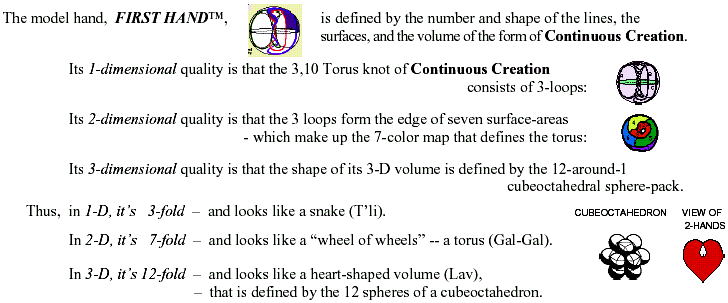
This is a unique identification. It includes identification of the descriptive words, T’li, Gal-Gal, and Lav, as well as their unique geometric relationship to the three numbers, 3, 7, and 12.
3. In the February 2002 issue of Scientific American, Steve Mirsky reports on research published in the November 29, 2001 issue of Nature, as follows: "...A region within Broca’s area known as Broadmann’s area 44, critical for the power of speech, is larger in the left hemisphere of humans than in the right. A study has now found that the same asymmetry exists in other great ape species: chimpanzees, bonobos and gorillas. [...T]he Emory University researchers conjecture that the area may have originally been associated with the production of gestures used by apes for communication. This area eventually became used as a source of speech in modern humans." [10]
References:
1. Penrose, Roger, The Emperor’s New Mind, Oxford University Press, 1989
2. Jaynes, Julian, The Origin of Consciousness in the Breakdown of the Bicameral Mind, 1976
3. Young, Arthur M., The Reflexive Universe, Anodos Books. Available through the Arthur Young website at www.arthuryoung.com/aybooks.HTML
4. Corballis, Michael, The Gestural Origins of Language, ©1999 Michael Corballis, published in The American Scientist, March-April 1999. This article is available at www.amsci.org/amsci/articles/99articles/Corballis.html
5. Acredolo, L. & Goodwyn, S. (1993). Symbolic gesture versus words: Is there a modality advantage for onset of symbol use, published in Child Development, 64, 688-701.
6. Iverson, Jana, and Goldin-Meadow, Susan, Why People Gesture When They Speak, published in Nature, Nov. 19, 1998. Excerpts available at www.meru.org/3220lecture/blndgest.html
7. Iverson, Jana, and Thelen, Esther, Hand, Mouth and Brain: The Dynamic Emergence of Speech and Gesture, published in the Journal of Consciousness Studies, Vol. 6, Issue #11-12, Nov/Dec 1999. Also see other published work linked to at www.meru.org/Gestures/gestures.html
8. Tenen, Stan, Man Bites Dog, published in the Noetic Journal, Vol. 2, No. 2, p.203, as an appendix to the essay The God of Abraham: A Mathematician’s View (see below).
9. Tenen, Stan, The God of Abraham: A Mathematician’s View, published in the Noetic Journal, Vol. 2 No. 2, p. 192.
10. Mirsky, Steve, Parts of Speech, published in Scientific American, February 2002, page 28.
Internet URLs and Links
Man Bites Dog
www.meru.org/manbitesdog.html
The God of Abraham, A
Mathematician’s View
www.meru.org/GodofAbe/onegdpix.html
Squaring the Circle: The One
and the Many, Mind and World
www.meru.org/3220lecture/contents.html
The Dirac String Trick: First
Hand
www.meru.org/dirac.html
The Light in the Meeting Tent
(poster)
www.meru.org/Posters/ColorLightinTent.html
The Light in the Meeting Tent
(Meru Archive Draft Article:
1986)
www.meru.org/lightintent/lightin.html
Unity and Wholeness
www.meru.org/Posters/Unitywho.html
The Geometry of Rumi’s
Description of the Mevlevi Sufi
Round Dance
www.meru.org/Sufi/rnddance.html
An Idealized Embryonic Fruit
and a Dancer’s Exchange of
Angular Momentum
www.meru.org/Posters/angumomt.html
Hebrew Alphabet Hand Gestures
www.meru.org/Gestures/Atbashgest.html
Why People Gesture When they
Speak (Excerpts) by Jana Iverson
and Susan Goldin-Meadow
www.meru.org/3220lecture/blndgest.html (see Reference 6 above)
The Gestural Origins of
Language, by Michael
Corballis,
www.amsci.org/amsci/articles/99articles/Corballis.html (see Reference 4 above)