
| Help Support Meru Foundation Research |
 |
A Mathematician's View Is there a mathematical argument for the existence of one God?
Reprinted from the peer-reviewed NOETIC JOURNAL, VOLUME 2 NUMBER 2 (April 1999)
Journal-reprint version available here (The God of Abraham-A Mathematician's View.A3lograf.pdf 513K)
©1993, 1996, 1999 Stan Tenen
A version in German was published in Tattva Viveka, Issue #5, October 1996, Frankfurt, Germany.
A shorter version was published in Gnosis #28, Summer 1993.
The Noetic Journal published
the accompanying piece to this
article, Man
Bites Dog, as an
Appendix to The God of Abraham.
This article is usually
published with copious
illustrations. A few of those
illustrations are reproduced
here; many more are available in
other places on this website. In
particular, the reader should
refer to the following Meru
Foundation Presentation Posters:
- CONTINUOUS CREATION
- The Hebrew Letters - FIRST HAND
- The 3,10 Torus Knot, Ring, Sphere, Tetrahelix and Hand
- The Light in the Meeting Tent - Graphic
- The ancient Chinese developed a cosmology and an original ideographic alphabet based on the 28-mansions of the lunar zodiac.
- The Greeks and the Persians modeled the cyclicity of life by a pantheon of gods, goddesses and their familial relationships based on the 12-houses of the solar zodiac.2
- The Druids of northern Europe modeled the self-propagation of life on the life cycles of trees and other growing things.
- All cultures model the same processes of the same overall unity of the natural world and each uses a different physical example to do it.
for an overview of our central model, with identifications from various cultures
for various forms of the Hebrew letters
for an understanding of the transition of the 3,10 torus knot from a ring onto a dimpled sphere, and how this forms the model of Continuous Creation
Unity exists when the Flame
is wedded to the Coal: Maximal
Asymmetry and Maximal Symmetry
THE GOD OF ABRAHAM: A Mathematician's View
The "idols" of sophisticated people are not literal stone effigies. Instead they are the cultural, social, and scientific paradigms of the societies in which they live.
The Talmud, expanding on the Biblical account, tells us that Abraham discovered the One-God while he lived in the house of his father Terach. Terach, we are also told, was an educated professional knowledgeable in the skills, philosophies and spiritual practices known in his homeland in "Ur of the Chaldees," a civilized and sophisticated city-state in "Babylonia."
The Talmud is the "oral" Torah given to Moses with the written Torah - The Five Books of Moses - at Mt. Horeb-Sinai. From: The Handbook of Jewish Thought, by R. Aryeh Kaplan (Brooklyn, N.Y, Maznaim Publishing Co., ©1979) page 42, and Kaplan's footnotes, bottom page 42 (see Note 1).
"It was into this pagan atmosphere that a most unique individual was born. From his earliest childhood,32 Abraham transcended his pagan environment33 and recognized that the world was governed by one Supreme Being.34 As one of the greatest geniuses of his time,35 Abraham was able to use his keen mind to see through the sham and falsehood of the values of his generation,and understand the true purpose of creation."1Abraham is at home. He is reflecting on the many idols of metal and stone and wood that his father makes and sells. He has a realization that these idols are dead and inert and he "discovers" the One-God. This is a paraphrase of the traditional story. How are we to understand it?
If we, as our scholars, assume that this story is to be taken literally, then Abraham realizes that the idols his father makes and sells are not alive, and thus not able to have any effect in the world no matter what or how they are prayed to and no matter what sacrifice is offered to them. We are assuming that a man whom we are told is educated and sophisticated would make and sell inert effigies as deities. If we met an educated and sophisticated person today we would not find it plausible that they would be in the business of selling idols. Why should we make that presumption about Terach?
Consider instead the following scenario. Terach, as an educated and worldly man, would know and appreciate the arts, sciences and spiritual beliefs of as many different peoples and cultures as were known in his world. We assume this of educated persons today. If this is so, then the "idols of metal and stone and wood" referred to in the traditional story are really the particular cultural embodiments of the arts, the sciences, and the sacred as they are known in various different cultures.
The "idols" of a sophisticated person are not, literally, stone effigies and statuettes. These "idols" are the cultural, political, social, and scientific paradigms comprising the world-views of the societies in which they (and we) live.
When we examine the spiritual beliefs and cosmologies of many ancient and modern cultures we find that they all include excellent models of certain essential qualities of life - albeit each in its own cultural context with its own particular perspective, emphasis and physical analogs.
Abraham, in this view, acts as a mathematician: he postulates a meaningful and functional definition of Unity. The mathematician's model makes use of none of the "garments" of the many different cultural embodiments. Even though it is a mathematical model that must make use of geometry and form (or formalism) to be expressed, it (the model, not the sacred) MUST be understood as a complete abstraction without physical embodiment. A good mathematician tolerates no unneeded embellishments.
This perspective suggests why the Abrahamic faiths absolutely prohibit "graven images" of God. Any "graven image" would be a physical representation of only one culture's iconography during one historical period - it could never be a timeless model of a universal underlying Unity.
Once we understand this mathematician's idea of God as a DEFINITION necessary for universality we can, perhaps for the first time, see how and why it is possible that the Abrahamic faiths' insistence that God is the ONLY-GOD could be literally true, and not just the chauvinistic religious puffery of these faiths - and in a way that does not impugn the validity of other religions. The definition of Unity is in no way prejudicial to any other view.
Even before Moses was given the Torah, it is possible that Abraham realized that this ultimate, Singular, definition of the universal One-God is also identical with the personal meditational experience of God. That the Immanence of All-There-Is and the Transcendent Singularity in our experience of meditation are one and the same may be the basis of Abraham's understanding of and belief in the One-God.
This suggests the truly extraordinary possibility that our ancient sages also realized that there is one particular mathematical definition of Unity that is also a model of the sequence of feelings, the "Yoga" and the "Hero's Journey", that leads to the meditational experience of Unity. The meditational experience may be the gnosis that personally validates and empowers these spiritual tradition(s).
Further, although the particular details and depth of understanding of the idea of an explicit definition of the Unity of God may have been most fully developed by the Abrahamic faiths, the principle was known and considered fundamental in other cultures as well. Terach and Abraham did not live in a cultural vacuum.
This is from Anne Macaulay in Lindesfarne Letter No. 14, p. 109 (emphasis added):
"And finally let us return to Apollo. It came as a shock to me to find that this god was derived from a geometric figure. This is no deified hero nor an archetypal godlet, but a synthesis of observed facts about the relation of the stars, the moon and sun to earth; it is a timepiece and a calendar; it is a statement of the laws of the heavens in terms of geometrical and mathematical elements which themselves exhibit absolute laws; and these laws also apply to music: this must surely be the music of the spheres. The concept is total and the harmonic nature of the music demonstrates the great harmony of creation. Apollo can thus be seen as the logos or in another sense as the definition of the absolute god."3From The Egyptian Miracle by R.A. Schwaller de Lubicz, p.147 (emphasis added):
"In Pharaonic Egypt (as also in India, incidentally, although with dangerous complications), Neter Netru, the one and only God who is unknowable, is an idea derived by logical conclusion."4It is evidence of considerable philosophical sophistication on their part that the sages of the ancient world were apparently aware of the necessity of identifying the One-God with an abstract definition of Unity.
SINGULARITY AND THE ONE-GOD
As many musicians and electronics enthusiasts know, "...the harmonic nature of...music demonstrates the great harmony of creation." (See Macaulay quotation, above.) Every musical pulse is made up of the sum of many pure sine-wave tones; an ordinary "square wave" is made up of many odd harmonics, and, by extrapolation, a truly infinite pulse w ould consist of a sum of all possible pure tones.
The way musicians examine the spectrum of musical harmonics is exactly the same as the procedure mathematicians call a Fourier Transform: a sharp loud pulse consists of a broad spectrum of pure tones. Likewise an infinitely loud, short, sharp pulse - which we could compare to a musical Singularity - would produce the harmonic spectrum of ALL tones - which we could liken to ALL-THERE-IS.
The Fourier Transform of ALL-THERE-IS, is a single pulse of infinite intensity and infinitesimal duration at the start of time - at creation. This suggests that the Big Bang unfolds the modern physicist's model of creation from an exquisitely singular and intense pulse that may be mathematically equivalent to Abraham's DEFINITION of the One-God.
THE FOURIER TRANSFORM between UNITY and WHOLENESS
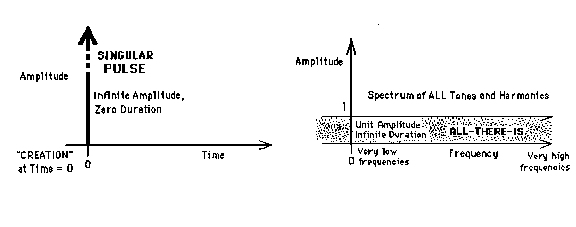
Fourier Transform of ALL-THERE-IS <=> Fourier Transform of PULSE
The Spectrum of ALL Tones and Harmonics, representing ALL-THERE-IS
is the Fourier Transform of the "Creation" Pulse.
If the universe is limited in extent and duration, then its ultimate source must be less than omnipotent. Thus the presumption of ONE exquisitely Infinite source demands that the universe be infinite, open and eternal. The Singular Pulse may be the Kabbalist's "line" (Qav) that extends from the "creation-contraction" (ZimZum) into All-There-Is. Abraham's definition of the One-God and our modern understanding of this universe may well be based on the same fundamental principles.
Here is another view that extends the idea of our closest logical singularity - the sun, the ostensible god of many ancient peoples - into a suitable definition of the Exquisite, Transcendental Unity of the One-God.
From physicist Roger Penrose's, The Emperor's New Mind, page 318-19, italics sic; [square brackets] and bold-face added for emphasis:
"Where indeed does our own low entropy come from? The organization in our bodies comes from the food that we eat and the oxygen that we breathe.
"The question is how we keep ourselves alive throughout out normal (mainly adult) lives. For that, we do not need to add to our energy content.
"...To keep ourselves alive, we need to keep lowering the entropy that is within ourselves.
"Where does this supply of low entropy come from?
"... green plants ... [provide] it by making use of sunlight. The light from the sun brings energy to the earth in a comparatively low-entropy form, namely in the photons of visible light. The earth, including its inhabitants, does not retain this energy, but (after some while) re-radiates it all back into space. However, the re-radiated energy is in a high-entropy form, namely what is called 'radiant heat' - which means infra-red photons. Contrary to a common impression, the earth does not gain [net] energy from the sun! What the earth does is to take energy in low-entropy form, and then spew it all back again into space, but in a high-entropy form. What the sun has done for us is to supply us with a huge source of low entropy. We (via the plant's cleverness), make use of this, ultimately extracting some tiny part of this low entropy and converting it into the remarkable and intricately organized structures that are ourselves.
"The energy the earth spews back into space is spread over many more degrees of freedom than is the energy that it receives from the sun. Since there are so many more degrees of freedom involved when the energy is sent back out again, ... the entropy has gone up enormously. The green plants, by taking in energy in a low-entropy form (comparatively few visible-light photons) and re-radiating it a high-entropy form (comparatively many infra-red photons) have been able to feed on this low entropy and provide us with this oxygen-carbon separation that we need.
"All this is made possible by the fact that the sun is a hot-spot in the sky."5Professor Penrose is telling us that the "raw" information needed to sustain the self-organization of life on earth is due to the "separation" - the distinction - between oxygen and carbon and this, in turn, is due to the distinction - the contrast - between the hot, bright sun and the cool, dark sky.
This model suggests why in traditional societies (as well as today) those who believe that life is entirely physical and that consciousness is an epiphenomenon of complex physical organization alone believe that the source of life is the Sun. Exclusive materialism is the equivalent of solar worship. In effect, materialists are not atheists. In this context, materialists can truly be said to worship the hot "metal and stone" idol the Greeks called Apollo.
Roger Penrose's TWISTER
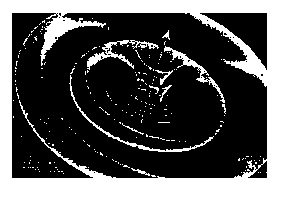
We can take Professor Penrose's observations one step further. After all, life on Earth reaches one further step of organization. Human beings (and perhaps a few other creatures such as some primates, elephants and the cetacea) are not only living animals - whose living neg-entropic organization comes from the contrast of the bright physical sun in the dark sky - but we are also conscious and aware of ourselves. Humans have a special hand with an opposable thumb marking our self-reflexive awareness and - some say consequently - we form and use language.
 We can take
Professor Penrose's observations
one step further. After all, life
on Earth reaches one further step
of organization. Human beings (and
perhaps a few other creatures such
as some primates, elephants and
the cetacea) are not only living
animals - whose living
neg-entropic organization comes
from the contrast of the bright
physical sun in the dark sky - but
we are also conscious and aware of
ourselves. Humans have a special
hand with an opposable thumb
marking our self-reflexive
awareness and - some say
consequently - we form and use
language.
We can take
Professor Penrose's observations
one step further. After all, life
on Earth reaches one further step
of organization. Human beings (and
perhaps a few other creatures such
as some primates, elephants and
the cetacea) are not only living
animals - whose living
neg-entropic organization comes
from the contrast of the bright
physical sun in the dark sky - but
we are also conscious and aware of
ourselves. Humans have a special
hand with an opposable thumb
marking our self-reflexive
awareness and - some say
consequently - we form and use
language. Following Penrose's argument, where does our "hyper" self-aware consciousness get its organizing information? What "hand" "informs" our special, "higher" human consciousness?
Does there exist or can we hypothesize a "higher" "hyper" contrast than between our star and the sky? Conceptually, at least, we can. The contrast between our physical sun and the sky can be idealized and extended by considering, at least in principle, an even higher, brighter source - a source of ALL-THERE-IS.
If the sun is a very bright, yet finite source, very far away, but not infinitely far away, then we could investigate the consequences of an infinite source at an infinite distance from us. We can define a model of an exquisitely singular and omnipotent source.
As with the Fourier Transform - musical harmonics ("music of the spheres") model, our extension of Professor Penrose's High Contrast leads us to an infinite pulse. (It is interesting to note that Kabbalists understand this principle of highest contrast as the paradox of God withdrawing or contracting (tzimtzum) and then projecting.) In this case the pulse is an infinitely energetic Singularity infinitely far away.
This then could be the "hyper"
source of our human self-aware
consciousness. This conceptually
farthest, brightest source is also
the conceptually highest
information, lowest entropy
source. It is the
"hyper-neg-entropic" source of
universal consciousness that
corresponds to the One-God. By
(Abraham's) definition this
is the most "high-contrast"
source.
MODELS OF WHOLENESS, SINGULARITY AND HIGHEST CONTRAST
How are we to model this ultimate, exquisite, unknowable UNITY representing our unique definition of the Singularity of the One-Living-God? Is there an entirely abstract - non-idolatrous - mathematical model that incorporates Singularity, Uniqueness, Self-organization, Universality, Infinitude, Elegance and Simplicity?
- What is the most elegant and exquisite model of "highest contrast"?
- Could this same model also represent the meditational process or the path and goal of the "Hero's Journey?"
"The theme of this book is that a universe comes into being when a space is severed or taken apart. The skin of a living organism cuts off an outside from an inside. So does the circumference of a circle in a plane. By tracing the way we represent such a severance, we can begin to reconstruct, with an accuracy and coverage that appear almost uncanny, the basic forms underlying linguistic, mathematical, physical, and biological science, and can begin to see how the familiar laws of our own experience follow inexorably from the original act of severance.
"Although all forms, and thus all universes, are possible, and any particular form is mutable, it becomes evident that the laws relating such forms are the same in any universe. It is this sameness, the idea that we can find a reality which is independent of how the universe actually appears, that lends such fascination to the study of mathematics."6

|
In Hebrew the letter that most represents this "mark of distinction" between inside and outside is Bet, the first letter of the Hebrew text of Genesis. It appropriately establishes, by definition, the first logical distinction possible. |
The distinction between archetypal Symmetry and Asymmetry is also primary and of absolute contrast. Each co-defines the other. Without a representative standard of asymmetry how could we unambiguously define symmetry?
Archetypal symmetry can be represented by the most compact structural forms (in any given dimension). The five Platonic solids (Tetrahedron, Cube, Octahedron, Icosahedron, and Dodecahedron) and the Archimedian semi-regular solids can define fundamental symmetries in 3-dimensions. (Mathematicians and physicists derive the formal symmetry groups that they use from these polyhedral archetypes.)
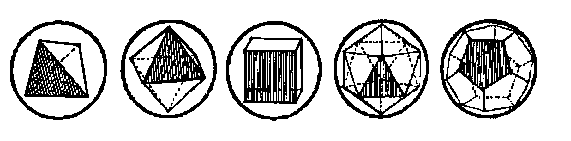
TETRAHEDRON OCTAHEDRON CUBE ICOSAHEDRON DODECAHEDRON
Archetypal asymmetry can be represented by a dynamic form that continuously breaks symmetries as it unfurls. Meru Foundation research suggests that this form is a particular, explicit vortex, which we call "Naked Recursion" ("naked" in the mathematical sense - unadorned, without any other quality) and which has been traditionally associated with "the flame of consciousness", the archetypal living process of a "fruit tree yielding fruit whose seed is inside itself" (Genesis I.11.), and with its highest human embodiment - our hands.
As we will see later, besides its traditional association with the heart Chakra, what is most astonishing about the vortex-shaped model HAND is its direct relationship to both our personal consciousness and to our cosmological model of Unity, Singularity and Wholeness.
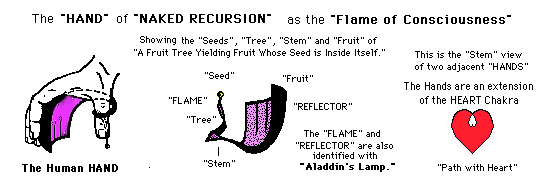
Traditionally mystics and Kabbalists have referred to the asymmetry vs. symmetry model of highest contrast as "Flame and Coal" (Absolute Unity can only exist when the "flame" is wedded to the "coal"),8 the "Light in the Meeting Tent," or, perhaps, in Plato as the "same (symmetric) and the different (asymmetric)" (although many other interpretations have been given for this phrase).
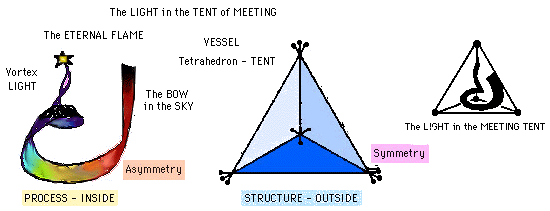
- In Taoism "hyper-contrast"
is modeled by the Yin-Yang
symbol:

Many representations of ultimate contrast are variations of the Inside and Outside model. These include the hypercube and hypersphere which are modeled by placing a small cube (or sphere) inside of a larger one. The In-Out direction models the fourth dimension.
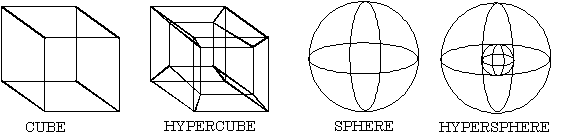
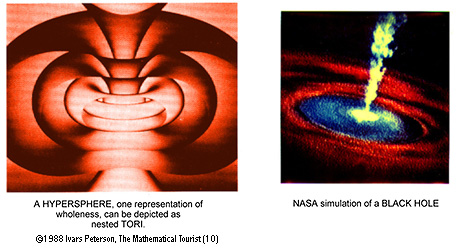
Following Eddington, mathematical philosopher Arthur M. Young in his The Reflexive Universe, points out that the surface of a 4-dimensional Hypersphere is the same as the volume of a solid Torus in 3-dimensions.9
In living things the Seed is INside and the Fruit is
OUTside, the Sperm is
INside and the Ovum is
OUTside:
| Flame and Coal Light and Vessel Seed and Fruit Wave and Particle |
Female and Male Spirit and Matter Mind and Body Transcendance and Immanence |
In these embodiments the asymmetrical dynamic element is conceptually INside (Seed, Mind, Spirit) with its symmetrical projective complement OUTside (Fruit, Body, Matter). See Note #2. There are very many other examples.
The modern physical concept of the complementarity of Wave and Particle as two mutually exclusive (highest contrast) aspects of all fundamental entities also models the Inside / Outside relationship.
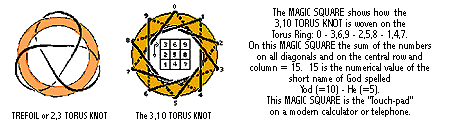
Mathematicians suggest that Singularities - formal mathematical definitions of Unity - can be modeled by Torus knots. Torus knots are simple "basket-weaving" or wreathes wound on rings. [For more complete illustration, see The 3,10 Torus Knot, Ring, Sphere, Tetrahelix and Hand.] The simplest knot is also the simplest Torus Knot. There are explicit vortex models based on particular Torus knots. The torus itself also defines the primary distinction between Inside and Outside.
TRANSITION of the 3,10 TORUS
KNOT from a RING onto a
DIMPLED-SPHERE
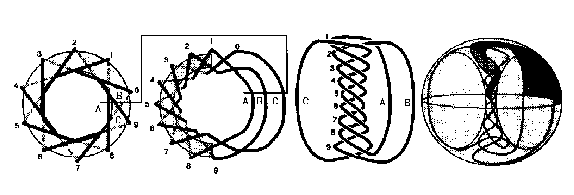
Break TORUS Ring and pull apart A, B, and C
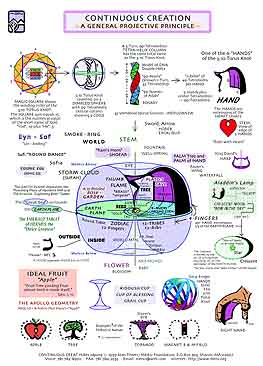
The illustration of CONTINUOUS CREATION is an attempt to show how a range of spiritual metaphors from different traditions can be reconciled in one geometric model of the High Contrast of Wholeness and Singularity. It shows some of the names by which the DIMPLED SPHERE Torus is known in different cultures and spiritual traditions. In this model, Continuous Creation refers to the unbroken chain of life: ...Seed-Tree-Fruit / Seed-Tree-Fruit / Seed-Tree... It represents the reflexive self-organizing process that is the natural transformation and unfoldment of every "SEED" (Singularity, Tao, Sun) via its "TREE" (Unfoldment, Flame, World Mountain) into new "FRUIT" (Wholeness, Hand, World) of its kind. It represents the general principle of the projection of life from life, endlessly. It is a model of one cycle of Singularity, Unfoldment, and Wholeness.
The IDEALIZED meditational "Fruit
tree yielding
fruit whose seed is inside
itself," in
the form of a DIMPLED-SPHERE
Torus, is
defined by pairing off the letters
in the first
verse of the Hebrew text of
Genesis.
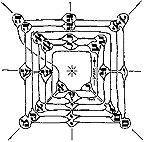
It is the minimal, most compact
and most elegant representation
of the sequence of letters in the
first verse.
CONTINUOUS
CREATION represents
the verse from Genesis (I,11) that
is quoted in the introduction to
the Sefer Zohar: "Fruit tree
yielding fruit whose seed is
inside itself."
The first verse of the Hebrew text of Genesis represents Naked (mathematically unadorned) Recursion (...acorn-oak-acorn-oak-acorn-oak....) in the form of a Human Hand.
- Perhaps the most startling quality of this HAND form of NAKED RECURSION is that when it is placed on our hand like a glove different gestures display all of the letters of the Hebrew Alphabet. The Arabic and Greek sacred alphabets are produced by a similar form.
The historical samples of the Hebrew Letters reproduced in our poster, The Hebrew Alphabet - FIRST HAND (below) are from Reuben Leaf, Hebrew Alphabets, 400 B.C.E. to Our Days. For each letter, the single right column (next to the printed letter name) shows the form of the letter from the Elephantine Papyrus, circa 300 BCE. The four samples in the middle are Merubah ("square-form") rabbinic script (often referred to as "Rashi" script) from Islamic Spain, circa. 1000-1300 CE.11
The far left column of Hebrew letters shows photocopy reductions of actual photographs of various views (shadowgrams) of the same physical model hand. [For a full-size rendition of this poster, see The Hebrew Alphabet - FIRST HAND.]
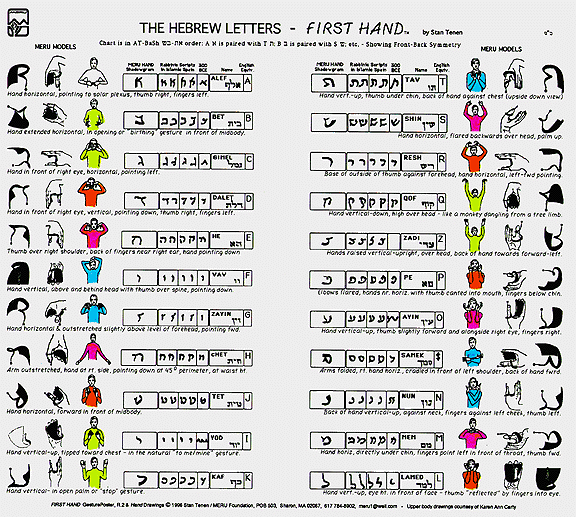
Because we can feel the model HAND on our hand and because we can always "see" our own hands in our mind's eye, we can also see the model HAND in our mind's eye. Close your eyes and point to the ceiling. You will find that you can tell how your hand is oriented and where your fingers are pointing even with your eyes closed. Now open your eyes and confirm that your inner vision of your hand was correct. This means that each gesture that displays a particular letter in our hand also displays that letter in our minds.
Since letters generated by hand gestures can represent directions of conscious focus in our minds, a sequence of these letters can be used to specify and reconstruct a meditation. This may explain why certain Scriptural texts were canonized and why these letters are rightly called "sacred." Thus the same letter-signs are elements of both cosmology and consciousness at the same time.
Meru Foundation research has also shown that because the natural meaning of hand gestures is universal for all humans,12 each letter displayed (and seen in the mind's eye) by each gesture has explicit meaning. For example, the name of the Hebrew letter Pe (Greek Pi, Arabic Fe, English "P") traditionally means "mouth" (or swallow, puff, or engulf). It can only be seen in the model hand when it is worn on our hand - within the limits of motion of our arms and wrists - when our hand points to our mouth, thumbs in, fingers flared, in a puffing gesture. Every other letter is similarly explicitly defined by the gesture that displays it to us. It is usually possible to "decipher" the operational meaning (not the idiomatic meaning) of root words in all languages (that can be phonetically related to Hebrew, Greek and Arabic) by examining the sequence of letters alone.
There are many other examples we could suggest from every culture and field of study.
Finally, there is the Hebrew word for Unity ("one"): E-cHoD. It means "archetypal acuteness or sharpness." (Aleph - "archetype of"; cHet - "encompassing"; Dalet - "dividing.") By its exquisite singularity, E-cHoD represents the essence of "highest contrast." The so-called "credo of Judaism," the Sh'Ma (in the daily prayer book) states that "..., God is E-cHoD (One, exquisitely Singular)."
This ancient model of the Unity of physics and consciousness is also compelling and potent in a modern sense. As physicist Nick Herbert notes in his discussion at the end of his book Quantum Reality, Beyond the New Physics:
-
"One
of the greatest scientific
achievements imaginable would be
the discovery of an explicit
relationship between the waveform
alphabets of quantum physics and
certain human states of
consciousness."13
- It appears that Abraham's model of the One-God and the Hebrew (Greek and Arabic) alphabet(s) that flow from it satisfy Professor Herbert's quest.
Although it is bound to be considered insulting (and thus to have no validity) by those who do not understand geometry and who therefore adhere to exclusively literal literary understandings of traditional spiritual traditions, there may in fact be no possible way to describe Exquisite Singularity without mathematics.
Although some sources insist that it is anecdotal, it is generally believed that over the entrance to the Platonic Academy it was written that:
"  "
"
"Only he who is familiar with geometry shall be admitted here."
Our spiritual traditions are the vessels of our faiths. The function of these vessels, like nut-shells or seed-husks, is to protect the kernel with its germ of life, the flame, the hand of the transcendent, inside. If these vessels had not survived, there would be no hope for rebirth of the germ - the "light" - they carry.
Perhaps our presumption that our sages of the past were not really knowledgeable or wise has blinded us from seeing their knowledge and wisdom. The Abrahamic claim of an exclusive, Singular and Unique One-God only appears to be prideful puffery when our sight is overly narrow and literal. We misinterpret our partial view of the "vessel." Once we are aware of the distinction between Inside and Outside, between "vessel" and "light," we can appreciate the true significance of the use of a real model of Singularity for the definition of the Oneness of God.
Kaplan's footnotes, from page 42 of The Handbook of Jewish Thought (Brooklyn, N.Y, Maznaim Publishing Co., ©1979):
32. Some say from the age of three; Nedarim 32a; Bereshith Rabbah 30:8, 64:4, 95:2; BaMidbar Rabbah 18:17; Shir HaShirim Rabbah 6:1; Esther Rabbah 6:5; Tanchuma, Lekh Lekha 3; Zohar 3:302a; Raavad. Avodath Kokhavim 1:3; Kesef Mishneh; Migdal Oz; Hagahoth Maimonioth 1, ibid.
33. Such as by ridiculing and destroying his father's idols: Bereshith Rabbah 38:19; Tanna DeBei Eliahu Zuta 25 (57a).
34. Bereshith Rabbah 39:1; BaMidbar Rabbah 14:7; Yad Avodath Kokhavim 1:3; Beth Elokim, Shaar HaYesodoth 48.
35. Abraham was thus the world's greatest astronomer; Bava Bathra 15a. He is also the leading personage of his time; Kiddushim 32b; Rambam on Genesis 26:29, 40:14.
Note #2:
It is interesting to note that in most of these examples the positions of the complements could be reversed. For example, in our models the geometric structure (Coal, Vessel, Particle, Tetrahedron, etc.) is considered to be "male" because these structural elements, represented by polyhedra, are rigid, discrete, and logically precise, while the complementary process (Flame, Light, Wave, Spirit, etc.) is considered to be female because the vortex forms which represent the process are cyclic, continuous, and dynamic (or "emotional"). But it could be the other way around:. The polyhedra could be seen as vessels and outside (like a womb) and thus "female" and the vortex forms could be seen as penetrating and inside (like a penis) and thus "male." This is similar to how Yin and Yang continuously flow into and mutually define each other as each becomes the other.
The ideas presented above are work-in-progress. There is much ancillary work that is not presented here and there is much work yet to be done. For further information, please contact us directly.- Stan Tenen, Meru Foundation, San Anselmo CA, 1993
References:
1R. Aryeh Kaplan, The Handbook of Jewish Thought (Brooklyn, N.Y., Maznaim Publishing Co., ©1979, page 42.
2Hugh A. Moran & David H. Kelley, The Alphabet and the Ancient Calendar Signs, (Palo Alto, CA, Daily Press, 1953,1969), pp. 13-31.
3Anne Macaulay, APOLLO: The Pythagorean Definition of God, (West Stockbridge, MA, Lindesfarne Letter #14: Homage to Pythagoras, 1982), pp. 85-110, quote p. 108-9.
4R.A. Schwaller de Lubicz, The Egyptian Miracle, (New York, Inner Traditions International, Ltd., 1985), p. 147
5Roger Penrose, The Emperor's New Mind, (Oxford, Oxford University Press, 1989), chapter 7: The Arrow of Time, pp. 302-347, especially Fig. 7.7; pp. 317-322.
6G. Spencer-Brown, Laws of Form, (New York, E.P. Dutton, 1979), from the Introduction: A Note on the Mathematical Approach, pp. xxix-xxx; chapters 1; 2, pp. 1-7.
7Keith Critchlow, Order in Space, (New York, The Viking Press, 1970). This book catalogs and illustrates the regular and semiregular polyhedra and their relationships to each other.
8David R. Blumenthal, Understanding Jewish Mysticism, (New York, Ktav Publishing House, 1978), from Sefer Yetzirah, Chapter 1, Mishna 7, translation, p. 17.
9Arthur M. Young, The Reflexive Universe, Evolution of Consciousness, (Lake Oswego, OR, Robert Briggs Assoc., 1988), pp. 265-7. Highly recommended for understanding of the process of self-reference and its relationship to the torus. For more information on the work of Arthur Young, see the Arthur Young Website at http://www.arthuryoung.com
10Ivars Peterson, The Mathematical Tourist, (New York, W.H. Freeman, 1988), Fig. 4.9, p. 96.
11Reuben Leaf, Hebrew Alphabets, 400 B.C.E. to Our Days, (New York, Bloch Publishing Co., 1950, 1976). This book gives historical samples of the Hebrew Alphabet.
12David McNeill, Hand and Mind, What Gestures Reveal about Thought, (University of Chicago Press, 1992).
13Nick Herbert, Quantum Reality, Beyond the New Physics, (New York, Anchor Press/Doubleday, 1987), p. 249.
This
article and its illustrations
(unless otherwise noted), and
all other material on this
page, are
©1993, 1996, 1999 Stan Tenen,
and licensed to Meru
Foundation,
524 San Anselmo Ave, Suite
214, San Anselmo CA 94960 USA
Email inquiries to: meru@meru.org